Is Supabase POPIA Compliant? Why It's the Wrong Question
POPIA judges what your business does with people's information, not the badge on your database provider's website. What the provider covers, where your data sits and what's left for you, whichever AI builder you use.
Quick answer
No backend platform is POPIA compliant or non-compliant on its own, and Supabase is no exception. POPIA puts the duty on your business, the responsible party. The platform is your operator: it stores and processes the information for you. Its security certificates cover its own systems. Whether your app is lawful depends on where the data is stored, the written agreement you have with the provider and the controls you build into the app.
Tools for this build
POPIA Compliance Checker
A readiness checklist for your backend's region, agreement and access controls. Runs in your browser.
PayFast Webhook Generator
If your app takes payments, generates the function that checks a notification's signature, with the signing secrets kept out of your code.
Custom Prompt Builder
Turns a gap the checker finds into a clear, bounded request for your AI.
Why is "is this platform POPIA compliant?" the wrong question?
Because POPIA regulates the business that decides why and how personal information is used, not the software it runs on. The Act calls that business the responsible party. A database provider like Supabase is an operator: it processes the information for you, under a contract. Compliance is something your business does, not something a platform has.
The Act's own definitions settle it. The responsible party is whoever "determines the purpose of and means for processing personal information". An operator is someone who processes it "for a responsible party in terms of a contract or mandate". If you built the app and you decide what it collects, the responsible party is you, even as a one-person business.
The same holds whichever AI builder you use, whether it connects you to Supabase, keeps your data in its own built-in database or asks you to bring one. The platform changes. Your role doesn't.
What the provider's security badges actually cover
Supabase, as the worked example, states on its security page that it holds two independent security certifications (SOC 2 Type 2 and ISO 27001), and that customer data is encrypted while it's stored and while it travels over the internet. Most serious providers publish something similar. These claims are real and worth checking. They tell you the provider runs its own systems carefully.
They say nothing about your app. POPIA's Section 19 makes you, the responsible party, secure the personal information in your possession or under your control with "appropriate, reasonable technical and organisational measures". If your app never switches on the rules that decide who can read which rows, a provider with perfect certificates will still hand every customer's records to anyone who asks.
Section 21 is where the provider comes in. You must have a written contract that makes the operator keep those security measures. Separately, the Act makes the operator tell you immediately if it has reasonable grounds to believe someone got unauthorised access. In practice that contract is the provider's Data Processing Agreement (DPA). Supabase says its DPA is available for customers who need a formal GDPR data processing contract, so check that it covers the security measures and how the provider will report a breach before you rely on it for POPIA.
Where does your data actually live?
In whichever region your project uses, plus anywhere backups, logs and connected services send copies. Many of the providers AI builders connect to have no data centre region in South Africa, so a typical AI-built app sends South African customers' information abroad from its first sign-up, often without the owner noticing.
Supabase, for example, asks you to pick a region when you create a project, and in September 2026 its region list had none in Africa. Its own documentation says a project is "bound to a region at the infrastructure level": moving it means creating a new project in another region and migrating the data across. That's why the question belongs at the start of a build, not after launch.
The main database region isn't the whole picture either. Backups, logs, email senders, analytics, file storage and any outside service your app calls can each hold personal information somewhere else. Your AI can list these for you from the code; the prompt further down asks it to.
What does Section 72 say about storing data outside South Africa?
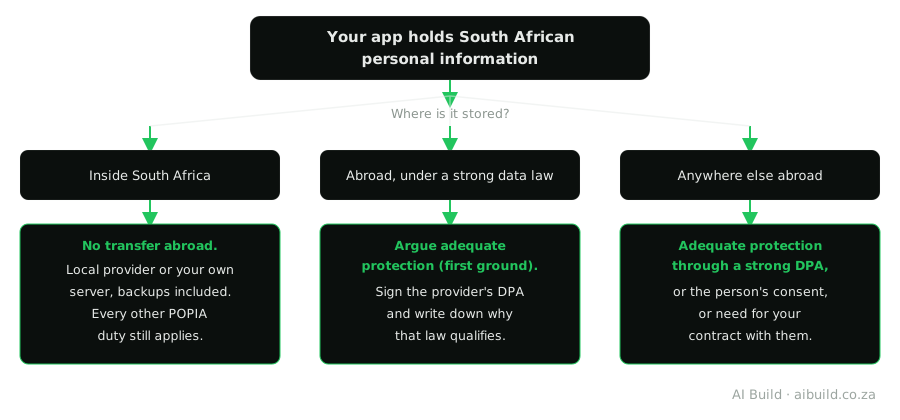
It doesn't ban it. Section 72 says a responsible party may not transfer personal information about someone to a recipient in a foreign country unless one of five grounds applies. For an app storing data with an overseas provider, the first ground, adequate protection, is usually the one to build your case on, with consent as the common fallback.
The five grounds, in plain words:
- The recipient is bound by a law, binding corporate rules or a binding agreement that gives an adequate level of protection.
- The person the information is about consents to the transfer.
- The transfer is needed to perform a contract between you and that person, or for steps they asked you to take before one.
- It's needed for a contract made in that person's interest between you and someone else.
- It's for the person's benefit, getting their consent isn't reasonably practicable, and they would likely give it if asked.
"Adequate" comes with a test, not a list of countries. The Act says the protection must uphold principles "substantially similar" to POPIA's own conditions for lawful processing, including similar rules on passing the data on to anyone else abroad. The Act itself names no countries. A region under a strong data-protection law, such as the EU's GDPR, makes that case easier to write down. A provider's DPA can count as the binding agreement wherever its servers are, if its terms genuinely match POPIA's. Either way, write down which ground you rely on and why, because as the responsible party the case is yours to make. It's also worth checking whether the Information Regulator has published guidance on cross-border transfers since this guide was checked in September 2026.
Storing data in South Africa is the clearest way round Section 72, but only with a South African provider or your own server, and only if backups and connected services stay local too. A foreign provider's South African region is less clear-cut: the Act asks whether the information goes to a third party in a foreign country, not only where the server sits.
Which cross-border rule applies to your setup?
What stays your job, whichever platform you pick
The sections above are mostly about where the data sits. The rest of POPIA is about how your app treats people's information, and no platform does that part for you:
- Collect only what you need. Section 10 says personal information must be "adequate, relevant and not excessive" for its purpose. Ask an AI for a sign-up form and it will often add a phone number, birthday and address you never use.
- Lock down who can read what. Supabase calls this Row Level Security, and most backends have an equivalent. The provider supplies the switch, and your app has to use it.
- Keep records only as long as you need them, then delete or de-identify them (Section 14).
- Give people a real way to see their information, and to correct or delete it when it's wrong or you no longer need it (Sections 23 and 24).
- Tell the Information Regulator and the people affected if there's a breach (Section 22).
- Register your Information Officer with the Information Regulator before they act for the business. The FAQ below explains who that is.
Checking your own setup in six steps
- Name the responsible party. That's your business, not the platform. Write it down, because every other step follows from it.
- Find every place the data lives: the database region, backups, and each outside service the app sends personal information to.
- Pick your Section 72 ground for anything stored abroad, and write down why it applies.
- Sign the provider's Data Processing Agreement and check it covers the security measures Section 21 requires and how the provider will report a breach.
- Switch on access rules for every table holding personal information, then test them logged in as a second user.
- Register your Information Officer and set up a way to answer requests to see, correct or delete information.
What to tell your AI: the data map prompt
Step two is the one people skip, because nobody knows every place their app sends information. Your AI can read the project and build that list for you. Paste this into the chat where you're building:
I need a POPIA data map of this app. Go through the code and settings you can see and list:

1. Every piece of personal information the app collects: the field, which form or page collects it, and why the app needs it.
2. Where each one is stored: which service, and which region or country if the settings show it. Write "unknown" if you can't see it. Don't guess.
3. Every outside service that receives personal information (email, analytics, payments, file storage, AI APIs) and exactly what it receives.
4. For each table holding personal information, whether access rules are switched on, and which tables have none.
5. Anything collected that the app never actually uses.
6. What happens today if a user asks to see or delete their information.

Present it as a table. Don't change any code yet.
What to check in its answer
- Every "unknown" region is a question for your provider's settings or documentation. Don't leave it blank.
- A table holding personal information with no access rules is the first thing to fix. Ask the AI to add them, then test logged in as a second user.
- Any field it marks as unused can come off the form.
- If the answer to point 6 is "nothing", that's a gap to close before launch.
- It's a starting map, not a legal opinion. The AI can only see what's in the project.
What isn't possible
- You can't buy POPIA compliance from a platform. No certificate, badge or plan upgrade moves your duties onto the provider.
- Your AI can't confirm where your data lives if the setting isn't in the code it can see. Check the provider's own settings or documentation.
- Choosing an EU region doesn't finish the job. It helps with one section of the Act, and the rest still applies to your app.
- Keeping data in South Africa doesn't finish it either. With a South African provider or your own server, and backups and connected services kept local too, there's no transfer abroad for Section 72 to govern, but every other duty above still applies.
- A guide can't replace a lawyer. For health, financial or children's information, get a South African data-protection lawyer to look at your setup.
Where to go next
- To work through your own setup question by question: the POPIA Compliance Checker.
- Not sure your app needs a database at all yet: When Does Your App Actually Need a Real Database?
- To make sure a login actually protects the data behind it: Adding Login and Google Sign-In to an AI-Built App.
Not affiliated with the platforms we write about, and not legal advice
AI Build South Africa is an independent resource. We're not affiliated with, endorsed by or an official partner of Supabase or any other platform named here. This guide explains general POPIA concepts from the Act's own text and uses Supabase's published documentation as an example; it isn't legal advice, and it doesn't replace a South African data-protection lawyer's view of your specific business. Provider regions, agreements and the Information Regulator's guidance change over time, so confirm current details before you rely on them. See our Terms of Service and Disclaimer for the full notice.
Frequently asked questions
Is Supabase POPIA compliant?
Not on its own, and no platform is. Supabase secures its own systems and offers a Data Processing Agreement, but POPIA puts the duty on your business as the responsible party. Whether your app complies depends on where its data is stored, the agreement you sign and the controls you build into the app.
Does Supabase have a South African data region?
Not when this guide was checked in September 2026: its region list covered North America, South America, Europe and Asia Pacific, with none in Africa. Check its current list before you create a project, because a project can't be moved to another region later without migrating everything to a new project.
What is an operator under POPIA?
An operator is a person or company that processes personal information for a responsible party in terms of a contract or mandate, without coming under that party's direct authority. Your database, email and hosting providers are usually operators. You stay the responsible party, and the duties stay with you.
Do I need an operator agreement with my database provider?
Yes. Section 21 says the responsible party must have a written contract that makes the operator keep proper security measures. The Act separately makes the operator tell you immediately if it has reasonable grounds to believe someone got unauthorised access. A provider's Data Processing Agreement is usually that contract, so check it covers security and how breaches are reported.
What does Section 72 of the POPI Act say?
It says you may not send personal information about someone to a recipient in a foreign country unless one of five grounds applies: adequate protection through a law, binding corporate rules or a binding agreement; the consent of the person the information is about; a transfer needed for a contract with that person; one needed for a contract in their interest; or a transfer for their benefit where asking isn't practicable and they would likely agree.
Do I have to register an Information Officer?
Yes. POPIA makes the head of a private business its Information Officer, and Section 55(2) says they may only take up their duties once the business has registered them with the Information Regulator. For a sole trader, that's the owner. Which database you use makes no difference to this step.
Related reading
- What Is a Database?: tables, rows and columns in plain English, and why the information in them is what POPIA cares about.
- Why You Can't Put an API Key in Your Frontend Code: the other way an AI-built app quietly gives away access to its data.
- Sending Transactional Email: an email provider is an operator too, and the same questions apply.
- Does POPIA Require a Cookie Banner for Google Analytics?: the same questions applied to an analytics service, where a cookie ID is personal information too.
- How to Connect Your Domain to Your AI-Built Website: the other Deploy & Hosting guide, for once the app sits on your own address and real visitors' details start arriving.